


Fervid Insights · Applied Digital Strategy
AI Visibility Can Reveal a
Business Knowledge Problem
That SEO Alone Cannot Solve
A business can know considerably more than its website makes knowable.
Ken Buis
Co-Founder & Principal Strategist
Fervid Solutions
Read the article
See the Fervid Approach
In this article
A Business Can Know More Than Its Website Makes Knowable
I have worked with enough businesses to know there can be a considerable difference between what an organization understands and what someone would conclude from its website. The people inside may have spent decades solving problems, learning which questions matter, where projects go wrong and what customers routinely misunderstand.
Much of that knowledge was never created for marketing. It developed through technical work, customer relationships, mistakes and thousands of decisions. Yet the website may offer only a thin account of it, despite having service pages, staff biographies and years of articles.
Organizational researchers have examined this problem for decades. Linda Argote and Paul Ingram describe knowledge embedded in relationships among people, tasks and tools, which helps explain why some expertise is difficult to transfer. Our practical concern is the gap between that distributed knowledge and what the business has made public.
A website does not automatically capture the meeting where someone explains why an approach failed, or the client conversation informed by twenty years of experience. Several people may collectively understand a problem better than any published page explains it. Their shared understanding still needs to be expressed in a form an outsider can use.
The company’s website is also only part of its public representation. Publications, reviews, professional associations and other sources can contribute to the picture external discovery systems encounter. The website remains the part the organization can govern most directly, even though it cannot control the whole picture.
This is where I think many discussions about AI visibility start too far downstream. I use the term here for observable appearances, citations, links and referral activity in AI-assisted discovery. It is not a single standardized metric, and different providers expose different evidence.
The first question quickly becomes, “How do we optimize this website for AI?” Before getting there, I would ask what relevant knowledge the business possesses that its digital presence does not yet make clear.
That question does not replace SEO or assume every visibility problem begins with knowledge. The constraint may be technical, the material may be too generic, or another source may answer the question better. But some businesses have considerable expertise without explaining what is distinctive or providing enough evidence for an outsider to assess it.
In those cases, search engines or AI systems are not necessarily failing to interpret good information. The useful knowledge may never have been made explicit, connected or supportable. Before prescribing another optimization tactic, it is worth determining whether the information worth optimizing is actually there.
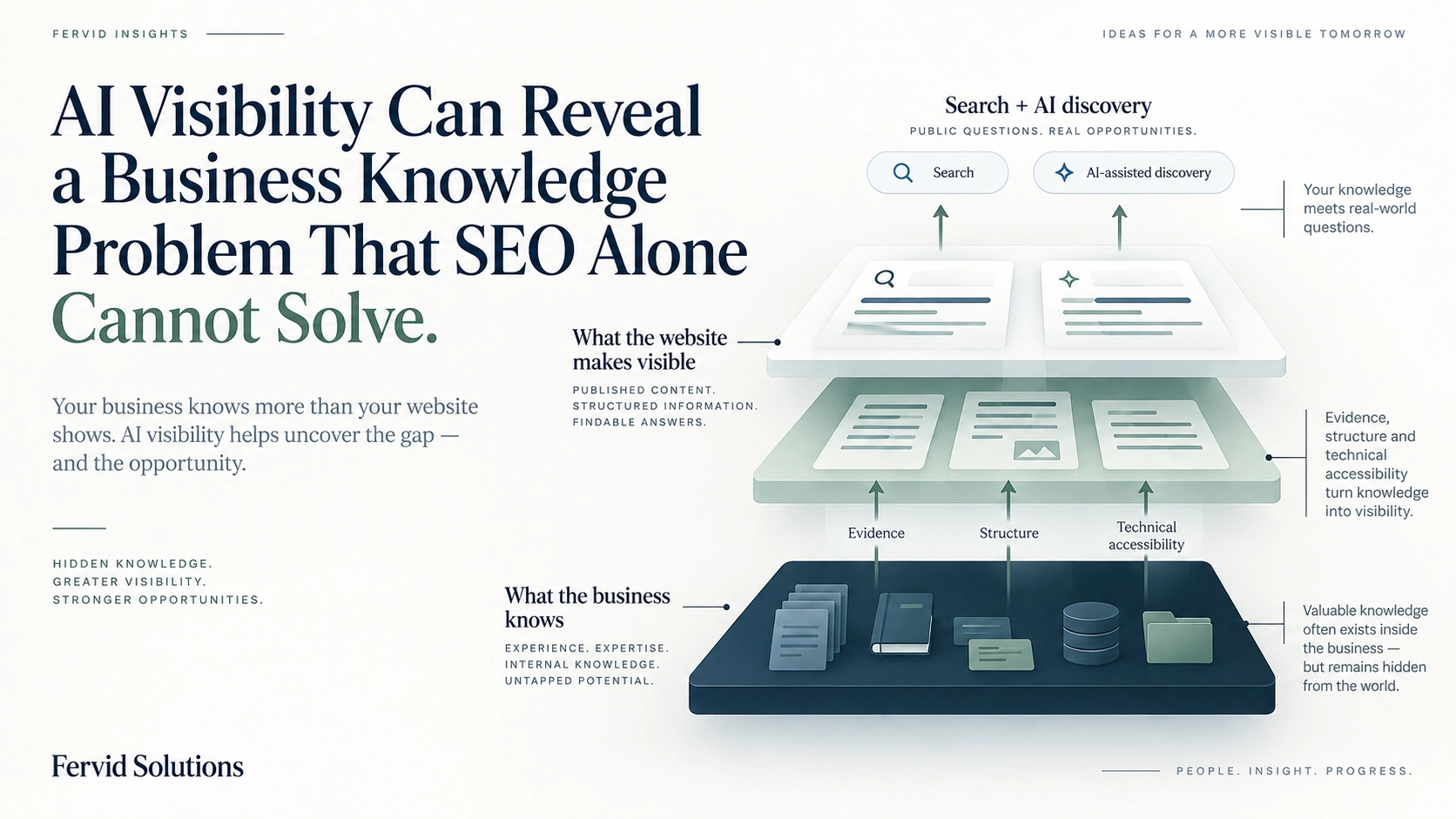
Business knowledge has to become clear, supportable public information before optimization has useful substance to work with.
Visibility Is an Observation, Not a Diagnosis
Suppose a company notices that a competitor appears regularly in AI-assisted answers where it does not. The competitor may be cited by name, its articles used as sources, or its services described more clearly. Something may need attention, but that observation does not identify the cause.
Important pages may be difficult to crawl, poorly linked or inadequately indexed. The material may be accurate but too generic to contribute much beyond what stronger sources provide. Expertise may be scattered across pages, or different parts of the site may contradict one another.
The explanation may also sit outside the website. A competitor may have stronger independent coverage, another source may answer the question more directly, or the query may favour different evidence. The discovery system may also follow a different retrieval path.
A 2026 study published through the Association for Computational Linguistics compared traditional Google search with five generative search systems from Google, OpenAI and Perplexity. It found differences in source diversity, the balance between internally held and externally retrieved information, and stability across systems and repeated executions. My interpretation is that businesses should examine the particular system and query rather than assume there is one stable mechanism describing “how AI sees your company.”
That matters when interpreting results. An appearance, citation and referral are different observations, each potentially useful when tracked consistently and connected carefully to other business evidence. None automatically explains why it happened.
A citation does not prove that structured data caused it. Increased AI referral traffic does not prove that a recent content change produced the increase. A competitor appearing more frequently may warrant investigation, but it does not establish that the competitor has found a superior optimization technique.
When we move too quickly from “this happened” to “this is why it happened,” we start building a story around incomplete evidence. The story may be plausible and may eventually prove correct, but that is not enough to justify prescribing work on its own.
The next step is therefore not automatically more content, more schema or another visibility tool. It is to investigate whether the constraint lies in technical access, the information itself, external sources or something we have not yet identified.
Sometimes the available evidence will not support a confident explanation. Good strategy includes recognizing that limit rather than recommending work simply because a familiar tactic is available. We need to distinguish what we know from the story we would prefer to tell.
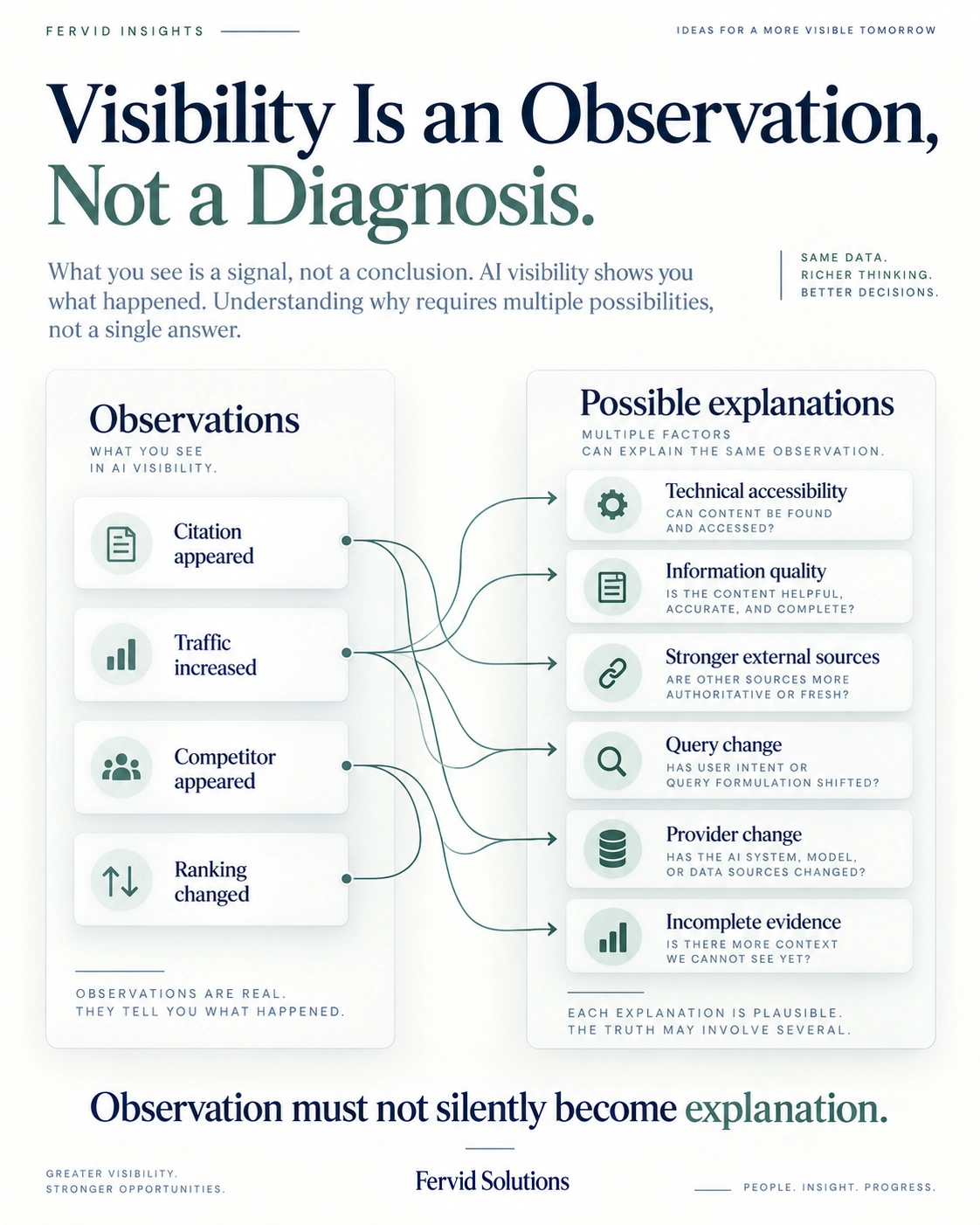
The same observed signal can have several plausible explanations. Diagnosis requires more than a dashboard change.
Expertise Has to Become Information
Knowing something and communicating it well are different things. Once a business decides that part of its expertise should become public, someone has to turn it into information another person can understand, evaluate and use.
An experienced professional may answer a difficult question by drawing on years of cases and judgement without separating every factor involved. A technical specialist may recognize why similar situations require different solutions. A website cannot assume that the reader shares this understanding; it has to explain the context and qualifications that make the answer useful.
That means deciding what is being claimed, what supports it, who possesses the expertise and where the explanation belongs. A service page, biography, article and technical reference may cover the same subject while helping readers make different decisions. Giving each a clear purpose matters as much as finding something to say.
Classic information-systems research on data quality offers a useful distinction. Richard Wang and Diane Strong found that quality involves more than accuracy, including contextual, representational and accessibility dimensions. Their study did not examine AI search, but its relevance to website information is worth considering: correct information can still be difficult to use when context is missing or the presentation is unclear.
Consider a company with a detailed expert biography, an article by that person and a service page covering the same subject. Each may be accurate, yet the site may leave readers to work out how the person, the expertise and the service connect. A relevant publication or credential may sit on another page, without any explanation of how it relates to the work being described.
This is why I prefer to treat a business website as an information system rather than a collection of pages. At Fervid Solutions, I want to understand what the site collectively communicates. Service descriptions should agree with articles, people should be connected to work they genuinely know, and important claims should have support. The test is whether someone outside the organization can follow the explanation without already knowing the business. I apply that test to the reader’s experience first, without assuming that clearer relationships will produce a particular search or AI outcome.
That does not mean every relationship needs structured markup or every idea needs a formal data model. The underlying information should make sense before we look for more sophisticated ways to describe it technically.
Nor is the objective to publish everything the organization knows. Some knowledge is confidential, some depends heavily on context, and some professional judgement cannot be captured completely in writing. The task is to select what is relevant, useful and supportable, then explain it without losing the qualifications that make it accurate.
A large content library can therefore leave important expertise poorly explained. Before adding more words, I would look at whether the existing material makes the relevant knowledge, evidence and relationships clear.
Isn’t This Just Good SEO?
An experienced SEO practitioner could reasonably argue that much of this already belongs inside good SEO. I agree. The work can include information architecture, content strategy, technical accessibility, internal linking, structured data and useful content. Reducing it to keywords and title tags would create an artificial distinction.
Google’s current guidance reinforces the overlap. It describes its generative Search features as rooted in core Search ranking and quality systems, with established SEO practices still relevant. That is not a separate technical world in which everything a business has learned about search stops applying.
I would not argue that organizational knowledge must be addressed before SEO begins. The work overlaps, and a technical problem may need immediate attention. A search review can also prompt useful questions about missing explanations or contradictory claims, bringing the business and its specialists into the same discussion.
The distinction is the nature of the problem. SEO can make an existing insight easier to find, improve how it is expressed and remove technical barriers around it. It cannot supply professional experience that never occurred, evidence the company does not possess or a decision about which conflicting service description is accurate. The SEO practitioner may identify the inconsistency, but the organization has to establish the truth.
That matters when AI optimization assumes the information already exists in finished form and simply needs different presentation. Sometimes presentation is the issue. Elsewhere, the organization still needs to make its knowledge explicit, supportable and coherent; another technical layer will not settle those questions for it.
Google also says its generative Search features do not require special AI markup, AI-specific rewriting, artificial content chunking or llms.txt. That guidance applies to Google, not every provider. It is a reason to examine the actual requirements rather than assume a new interface demands an entirely new set of tactics.
There is still new work to understand, but the label should not determine the intervention. For me, the useful question is what prevents relevant knowledge from becoming clear, accessible and discoverable in this particular organization. Once we understand that, we can choose the work on its merits rather than its name.
What Optimization Cannot Manufacture
There is a point where better optimization stops being the answer because the problem is no longer mainly one of presentation or discovery. An editor can help an experienced professional explain a difficult idea, information architecture can connect that explanation to the right services and evidence, and technical SEO can remove barriers that make useful pages harder to crawl or process. Structured data can describe relationships that are already there.
All of that can improve how expertise is represented. It cannot supply the substance underneath it. A polished author page does not create professional judgement, structured data does not strengthen evidence that never existed, and publishing several articles on a subject does not make the thinking more distinctive simply because it occupies more URLs.
This is where I become cautious when an authority problem is translated too quickly into a content-production problem. Sometimes new content is exactly what is needed because a business has useful knowledge that has never been expressed publicly. In other cases, the organization first needs to decide what it actually believes, reconcile conflicting descriptions of a service, determine which claims it can support or involve the people who genuinely understand the subject.
That is not really an optimization problem yet. It is a problem of knowledge, evidence and judgement.
A 2026 article in Knowledge Management Research & Practice makes a related point in the context of organizational GenAI. The authors argue that meaningful use of generative AI depends on well-managed, accessible and sufficiently rich knowledge assets, and that adding a more capable AI layer does not by itself repair fragmented knowledge or weak governance.
That paper does not study external AI-search visibility, so it cannot tell us that stronger knowledge management will produce more citations. Its value here is narrower: it reinforces the idea that technology does not remove the need for a sound knowledge environment. Applying that principle to public discovery is a Fervid interpretation, not a finding of the study.
If a business has not resolved what it wants to say, another optimization layer may simply make the uncertainty easier to find. If important evidence is missing, better markup will not supply it. SEO, content strategy and technical implementation can make good thinking clearer, better connected and easier to discover, but they should not be expected to replace the professional judgement and evidence that give the information value.
That boundary matters when the objective is described as AI visibility. The pressure to produce something new should not outrun the more basic question of whether the material adds anything worth discovering.
Good Information Still Does Not Guarantee AI Visibility
The argument also has a limit in the other direction. A business may have real expertise, strong evidence, clear authorship, coherent architecture and sound technical implementation and still not appear in a particular search result or AI-generated answer.
Clear, accessible information can improve the conditions for discovery without creating control over selection. Google, OpenAI, Microsoft and other providers make their own decisions about crawling, indexing, retrieval, ranking, source selection and presentation, and those decisions can vary by query, product and changes to the underlying system.
For that reason, I prefer to think in terms of discovery readiness rather than guaranteed visibility. A business can remove technical barriers, improve the quality of its information and monitor where it appears. The final selection still belongs to the external system.
Google’s current documentation makes that boundary explicit: following its technical requirements and recommended practices does not guarantee crawling, indexing or serving. OpenAI likewise explains how publishers can make content available to ChatGPT Search without offering a formula that guarantees citation for a particular query. Microsoft makes a similar distinction in Bing Webmaster Tools, where AI citation metrics describe observed citation activity rather than ranking, authority or a page’s importance within an answer.
That matters because citation, referral traffic and commercial outcome are different observations. If an article begins appearing as a cited source, the citation is worth recording. If referrals or enquiries follow, those observations matter too. What we should not do is collapse them into one causal story without enough evidence to connect the events.
The same discipline applies when visibility declines. A source may disappear because the query changed, the provider changed, stronger material became available or a different retrieval path was followed. Comparative research on generative search has found meaningful variation between providers and repeated executions, which makes simple cause-and-effect explanations risky.
There is also legitimate academic work on techniques intended to influence source visibility in generative systems. Research into Generative Engine Optimization deserves attention because it tests interventions under defined conditions. What it does not provide is a universal commercial formula. An effect observed in one experimental setting does not tell us how every production system will behave, how durable the effect will be or whether more visibility will produce a meaningful business outcome.
That evidence ceiling defines the difference between improving readiness and promising results outside the organization’s control. At Fervid Solutions, the practical position is restrained: improve the parts of the information environment you can responsibly influence, then observe what external systems actually do.
Your Website Is Only Part of the Information Environment
There is another reason I would be careful about treating AI visibility as a website-only problem.
Your website matters because it is the part of your public digital presence you can govern most directly. You decide what it says, how information is organized, which experts are identified and what evidence is included.
But the website is not the entire information environment. External systems may also encounter information about your organization through publications, professional associations, reviews, directories, government sources and other websites. Depending on the system and query, those sources may contribute meaningfully to how the company is represented.
That means a business does not control the entire public picture. If the company describes itself one way while credible external sources describe it differently, the first-party version does not automatically prevail. The reverse is also possible. An established business may be understood reasonably well through external coverage even when its own website explains very little.
I would therefore treat the website as the part of the public information environment the organization can govern most directly, not as the whole environment. The goal is not to create one perfect site and assume everything else will follow. It is to make sure the information the business does control is accurate, current and supportable.
If a service changes, the website should reflect it. If named experts are central to the work, their relationship to that expertise should be clear. If an old claim no longer holds up, it should be revised rather than repeated more confidently.
The same principle applies when external information is wrong or outdated. Repeating the preferred version more often on the company website may not resolve the discrepancy. Where practical, I would rather understand the source of the inconsistency and determine whether it can be corrected there.
Comparative research on generative search has found meaningful differences in the sources providers use and in their reliance on internally held versus externally retrieved information. That does not tell us how every future system will behave, but it is enough to reject the assumption that all AI-assisted discovery is working from the same source environment.
For a business, the conclusion is modest. Make first-party information as clear and defensible as possible while recognizing that authority is not established by first-party claims alone. The organization can govern its own representation carefully without pretending it controls every source an external system may use.
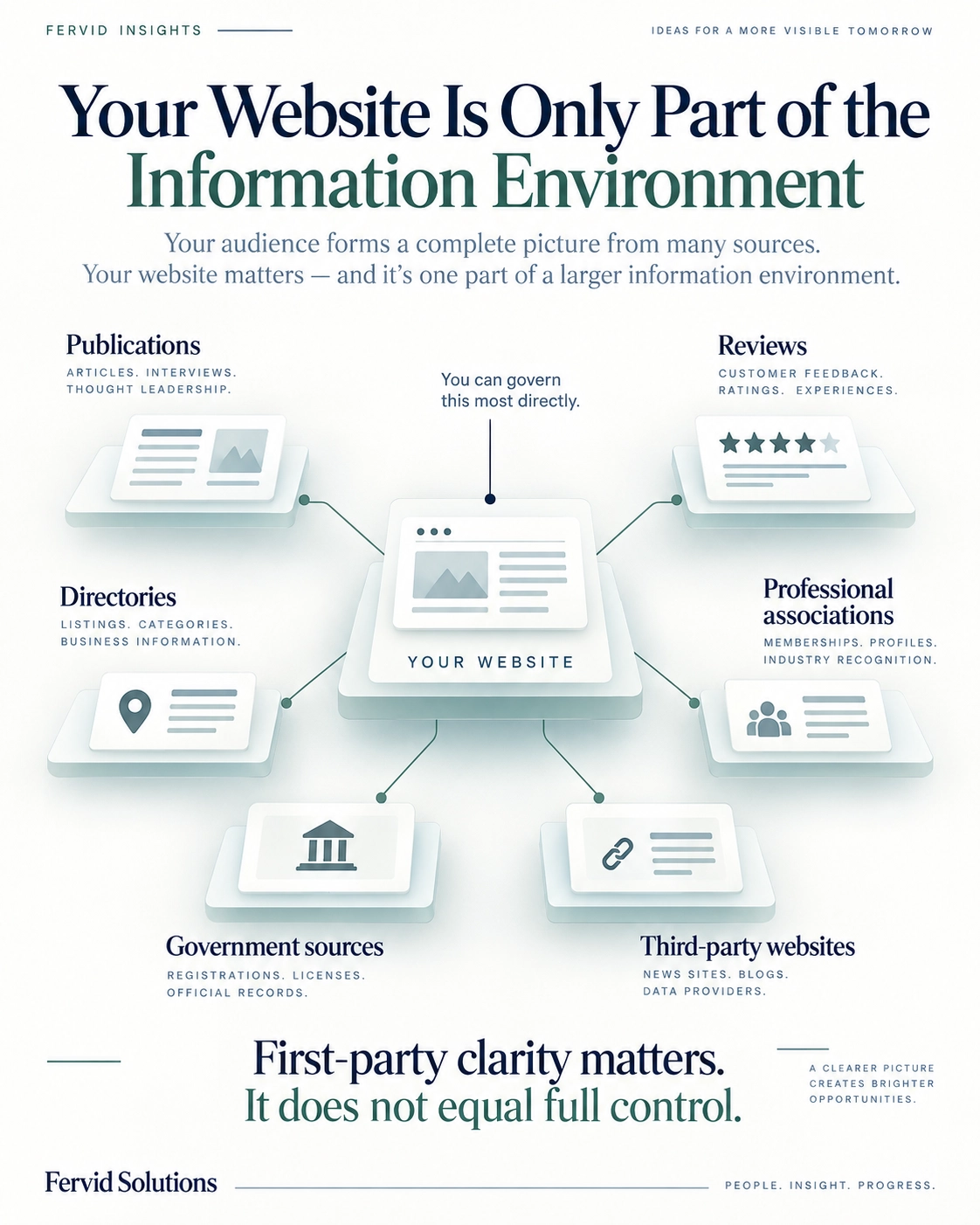
First-party clarity matters, but the public representation of a business can also draw on credible sources outside its own website.
Diagnose the Information System Before Prescribing the Tactic
Once we separate business knowledge, public representation and external discovery, the useful question is not which AI tactic to use. It is where the actual constraint sits.
A checklist can help once the problem is understood. Before that, it can create a great deal of activity without much confidence that the activity is addressing the right thing.
At Fervid Solutions, I would begin with purpose and audience. The business needs to know what a particular audience is trying to understand, evaluate or decide, and why that matters. Without that starting point, even a knowledge audit can turn into another form of content production. A company may possess enormous expertise, but not all of it belongs on the public website.
From there, I would look at the relevant knowledge itself: what the organization genuinely knows about the problem, where that expertise lives and which parts of it are distinctive enough to help someone make a better decision.
Evidence comes next. Some statements are factual, some are professional judgements based on experience, and others may simply be old marketing claims that have been repeated without much scrutiny. Those distinctions matter because stronger wording does not make a weak claim more supportable.
Identity is another part of the same problem. The site should make it reasonably clear who actually knows the subject and how those people or teams connect to the work being described. Too many business websites flatten real expertise into a generic company voice.
Then I would look at articulation. Internal distinctions that feel obvious to the organization often disappear on the page, especially for someone encountering the business for the first time. The important question is whether the relevant knowledge has been explained clearly enough to be useful outside the organization.
Only after that do I look at representation as a whole. Service pages, articles and biographies should not tell conflicting stories. Terminology should be coherent enough to follow, and a reader should be able to move from a problem to the relevant expertise, evidence and service without reconstructing the company for themselves.
The technical layer comes next. Search engines and other relevant systems still need to reach and process the information. Pages need to be crawlable and render appropriately, important material needs to be indexable, internal links should expose useful relationships, and conflicting canonical signals or duplicate URL variants should not create unnecessary ambiguity around the preferred version.
This is where conventional SEO remains essential, but it is solving a defined technical problem rather than being asked to compensate for weaknesses everywhere else in the information system.
From there, we can examine discovery. Traditional search results, AI-generated answers, referrals, external mentions and third-party publications each provide different evidence about where the organization is appearing.
The final stage is interpretation. A citation tells us a citation occurred. A ranking tells us where a page appeared. A referral tells us where a visit came from. A lead tells us someone acted. Those events may eventually form a useful chain of evidence, but timing alone does not prove one caused the next.
Different constraints require different work. Strong expertise with poor technical accessibility is not the same problem as excellent technical SEO with little useful information behind it. A business with hundreds of overlapping pages may need consolidation rather than another content programme. In other cases, the evidence may simply be too weak to justify a confident prescription.
That is why strategy should come before the tactic. Continuing to observe when the evidence is incomplete is not indecision. It is part of doing the diagnosis properly.
Even after the diagnosis improves, one more risk remains: the tool, platform or service already on the table can influence how we define the problem in the first place.
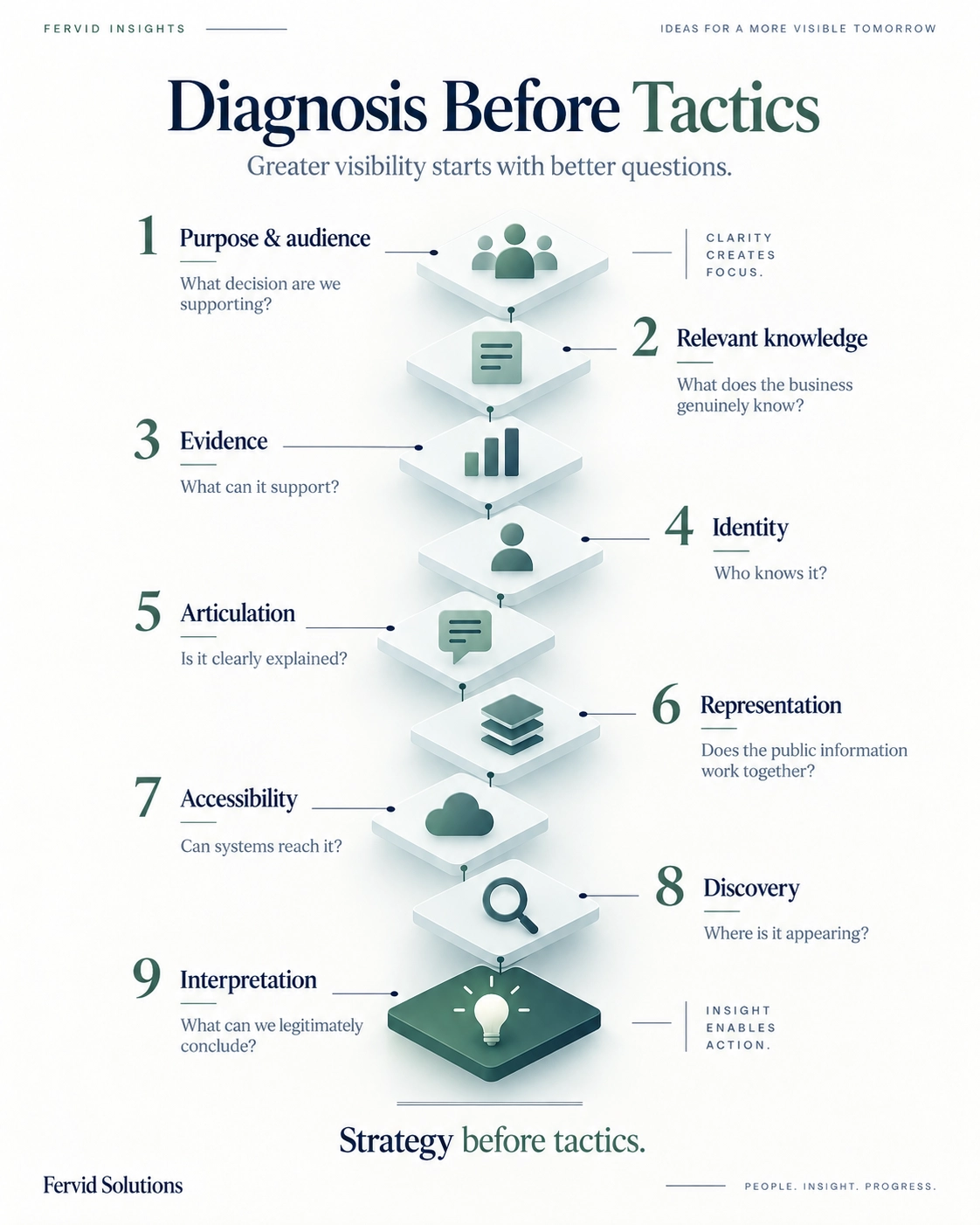
The sequence is a way to locate the constraint, not a claim about the internal architecture of every AI system.
When the Available Tactic Starts Defining the Problem
The growth of AI-assisted discovery has created a predictable market response. New tools, audits and consulting services are appearing quickly, and some are useful. I do not think businesses should dismiss this work simply because it is new. The more important question is whether the available solution is starting to define the problem we think we have.
This is not unique to AI visibility. A content company will naturally see content opportunities, an SEO platform will expose search and technical issues, and an AI visibility tool will show where a company appears or disappears over time. The risk is that every tool and service views the organization through the part of the system it knows how to change.
That can quietly shape the diagnosis. If citation monitoring is the starting point, citations can begin to look like the central business problem. If a content audit starts with keyword gaps, more pages may appear to be the obvious answer. If a technical assessment uncovers structured-data opportunities, schema can begin to look more important than the information it is describing. The problem is not necessarily poor work. It is competent work applied to the wrong constraint.
A business with dozens of overlapping articles may need consolidation rather than another content programme. A company with technically sound structured data may still have vague or unsupported claims underneath it. An AI visibility dashboard can reveal useful changes while telling us little about why they happened or whether they matter commercially.
That is why I would apply the same standard here that I would apply to any other digital investment. Before choosing the intervention, we should be able to explain what we believe the constraint is, what evidence supports that diagnosis and what would have to change before we considered the work successful. No consultant, agency or software provider directly controls whether an external system will organically rank, retrieve, cite or select a particular source. We can improve the conditions around discovery, but that is different from controlling the final selection.
Google’s current guidance is a useful example. For its own generative Search experiences, Google does not currently require special AI markup, AI-specific rewriting, artificial content chunking or llms.txt. That applies to Google, not every provider. The broader lesson is simply that a new interface or tool does not automatically mean an entirely new business problem has appeared.
Sometimes the right investment will be technical SEO. Sometimes it will be better information architecture, clearer evidence, stronger expert involvement or less content rather than more. In other cases, the evidence may not yet justify another intervention. For me, that is where strategy earns its place: the question is not simply whether a tactic can work, but whether it is the right response to the problem we have actually diagnosed.
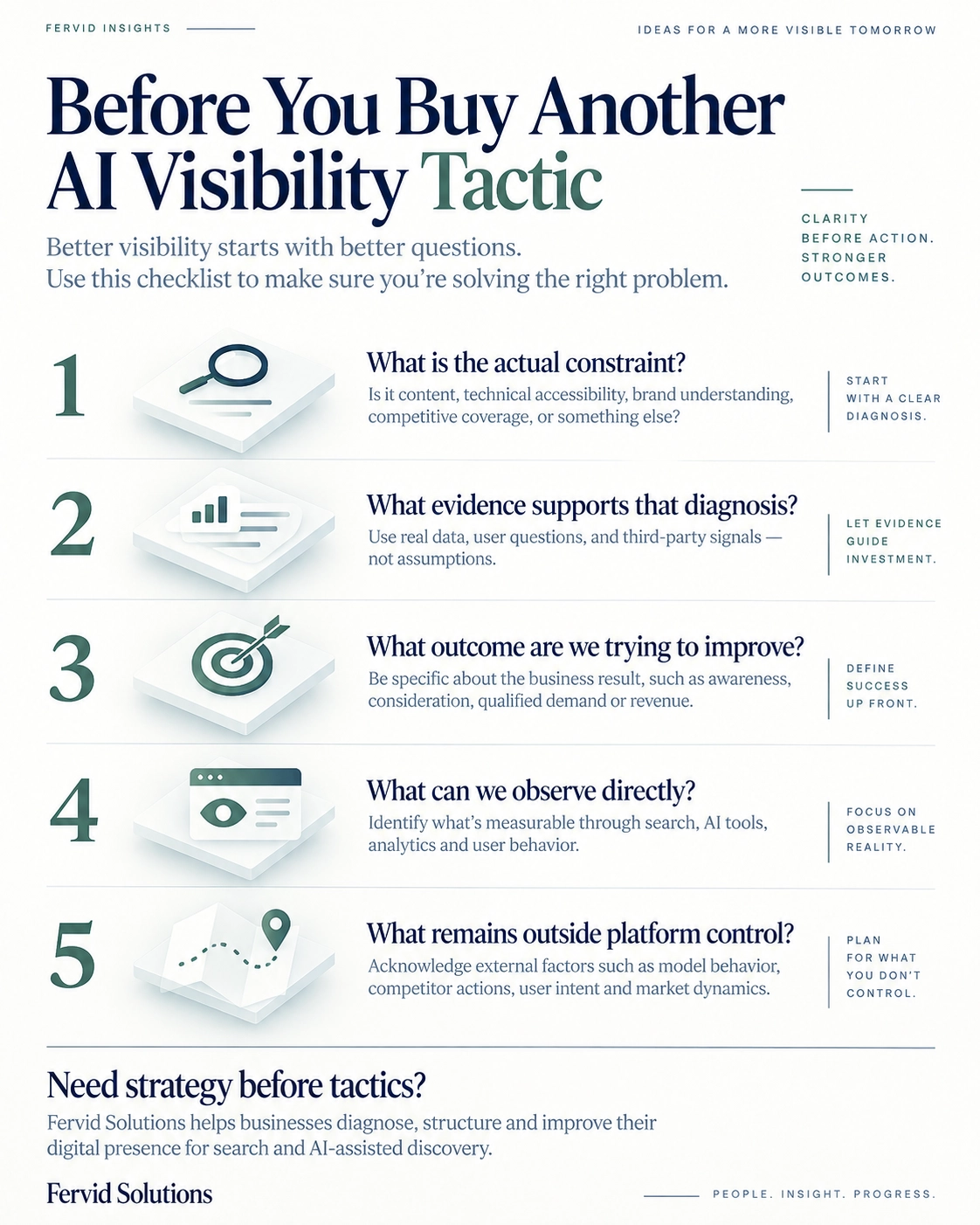
A tactic can be technically competent and still be the wrong investment for the problem in front of you.
Build for Clarity Before You Chase the Citation
We began with a simple observation: a business can know considerably more than its website makes knowable. The gap can involve knowledge that has never been articulated, evidence that is weak or missing, information that is poorly connected, technical barriers to discovery or external systems that choose different sources.
That is why I would not begin an AI visibility conversation by asking how to get cited. I would begin by asking what the business needs an audience to understand, what relevant knowledge it possesses, what it can support, how clearly that knowledge is represented and whether the systems trying to discover it can access what is there.
The objective is not to make a business appear knowledgeable to machines. It is to represent genuine, useful and supportable knowledge as clearly as possible for the people and systems trying to understand the organization. That work has value beyond any particular AI interface. Clearer services, stronger articles, credible expert biographies and better connections between them make the business easier to understand regardless of how someone arrives.
Search and AI systems may benefit from the same clarity, but the organization still does not control what an external system retrieves or selects. What it can control is whether the information available to be discovered is an accurate and useful representation of what it genuinely knows.
Once that foundation exists, optimization has something worth helping people and systems find.
KB
Co-Founder & Principal Strategist · Fervid Solutions
About Ken Buis
Ken Buis works across digital strategy, search and AI-assisted discovery, website architecture, content, analytics and technical implementation. His focus is on understanding the business problem, examining the available evidence and identifying which changes deserve attention.
Research & References
This article draws on research into organizational knowledge, data quality and generative search, together with documentation from Google, OpenAI and Microsoft. The application of this material to business diagnosis is Fervid Solutions’ interpretation. The cited research does not establish that better knowledge management guarantees AI visibility, or that a particular website change causes an external system to select a source.
Organizational knowledge & information quality
Peer-reviewed research
Argote, L. & Ingram, P. (2000). Knowledge Transfer: A Basis for Competitive Advantage in Firms.
Organizational Behavior and Human Decision Processes, 82(1), 150–169.
Peer-reviewed empirical research
Wang, R. Y. & Strong, D. M. (1996). Beyond Accuracy: What Data Quality Means to Data Consumers.
Journal of Management Information Systems, 12(4), 5–33.
Conceptual research article
Hussinki, H., Mikalef, P. & Ritala, P. (2026). Generative artificial intelligence and organizational knowledge management: four alternative configurations.
Knowledge Management Research & Practice. Used for its theoretical argument about GenAI and knowledge-management foundations, not as evidence of external AI-search causality.
Generative search & retrieval research
ACL 2026 research
Kirsten, E. et al. (2026). Characterizing Web Search in the Age of Generative AI.
Findings of the Association for Computational Linguistics: ACL 2026, 10827–10848.
ACM KDD 2024 research
Aggarwal, P. et al. (2024). GEO: Generative Engine Optimization.
Proceedings of the 30th ACM SIGKDD Conference on Knowledge Discovery and Data Mining. Results remain tied to the benchmark and experimental conditions examined.
Primary platform documentation
Google Search Central
Optimizing Your Website for Generative AI Features on Google Search.
Provider-specific guidance on foundational SEO, technical eligibility and Google’s generative Search features.
Google Search Central
Canonicalization.
Used for the technical distinction around duplicate URL variants and canonical preference signals.
OpenAI
Searching the Web with ChatGPT.
Provider documentation concerning ChatGPT Search, inclusion and non-guaranteed placement.
Microsoft Bing
Introducing AI Performance in Bing Webmaster Tools Public Preview.
Used for the distinction between observed citation activity and conclusions about ranking, authority or business effect.
Living Content System™
Reviewed as search and AI-assisted discovery evolve.
This article is maintained under the
Living Content System™ by Fervid Solutions.
Its research foundation, provider-specific statements,
technical guidance and evidence boundaries are reviewed
together when the underlying context materially changes.
System review
September 11, 2026
Human review required for material updates
- Primary question
- Where is the actual constraint behind an AI-visibility problem?
- Evidence scope
-
Organizational knowledge, information quality,
generative-search research and primary platform guidance - Reader decision
- Diagnose the problem before choosing the tactic
- Review cadence
-
Quarterly and when material research,
platform guidance or technical behaviour changes
What this review monitors
Research, platform guidance, technical reality and evidence boundaries
-
Google Search guidance covering generative Search,
technical eligibility and foundational SEO. -
OpenAI documentation covering ChatGPT Search,
publisher access and non-guaranteed placement. -
Microsoft Bing definitions for AI citation
and visibility measurement. -
Peer-reviewed research comparing generative-search
retrieval and source behaviour. -
Research into organizational knowledge,
information quality and knowledge management. -
The distinction between observed visibility,
causal explanation and business outcome.
Editorial maintenance rule
Material changes trigger review, not silent rewriting.
The approved article remains the source of visible meaning.
Material changes to research, provider documentation,
technical claims, evidence boundaries or the article’s
central proposition require human review before the page is updated.
LCS
Work With Fervid
Bring Fervid
the problem.
You do not need to arrive with the diagnosis.
Tell Fervid what you are trying to accomplish, what is not working
as well as it should, what has already been tried and where the
business needs to go.
From there, we can determine what deserves attention, what kind of
work makes sense and whether Fervid is the right fit.
Start a Conversation
↗
See How Fervid Works
→
Start with the problem. We can work out the solution from there.